1.3
The Kremlin’s lost battle in Moldova
Russia’s recent bid to unseat Moldova’s pro-Western government has failed.
The Kremlin is analysing the lessons, drawing conclusions and updating its methods.
Russia is almost sure to make another attempt to seize control of Moldova’s state institutions.
Last September, the Kremlin intervened forcefully in Moldova’s parliamentary elections with the aim of toppling the country’s pro-Western government. Open-source information suggests that Moscow spent around 150 million dollars on this massive influence campaign, deploying virtually every tool in its arsenal. And it lost.
ORCHESTRATED BY THE PRESIDENTIAL ADMINISTRATION
The influence campaign against Moldova originated directly from the Kremlin. It was devised within the Russian Presidential Administration and was implemented directly from it.
The campaign drew on an extensive toolkit that ranged from familiar, “soft” tactics to measures with a distinctly military flavour.
At one end of the spectrum, there were propaganda, disinformation and smear campaigns, which have long been key staples of Russian influence activity. For decades, Moscow-controlled TV channels, newspapers, websites, and social media platforms have consistently targeted their audiences with a steady, methodical approach. However, the campaign against Moldova introduced several innovations. For instance, after receiving training in Russia, clergy from the Moldovan Orthodox Church shifted their propaganda activity to social media, where they disseminated Russian disinformation in a modern, digital format.
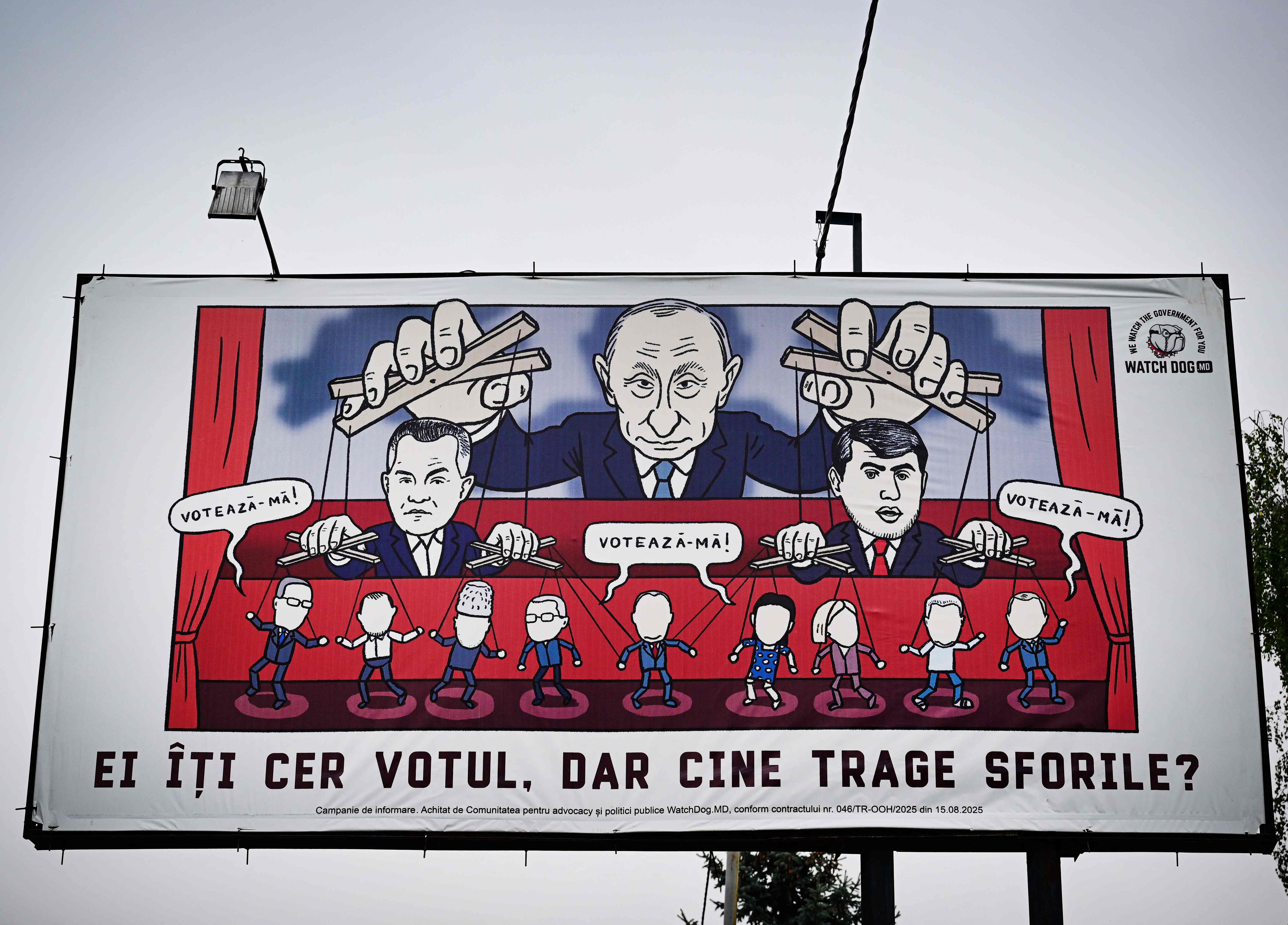
A pre-election cartoon in the Moldovan city of Ungheni: “They are bidding for your votes. But who is pulling the strings?” The cartoon depicts Moldovan politicians Ilan Shor and Vladimir Plahotniuc, who have ties to Russia, portrayed as puppets controlled by Vladimir Putin. Source: Daniel Mihailescu (AFP)
At the other end of the spectrum were strike groups composed of men with tactical and military training. Their tasks during and after the elections involved staging violent provocations, clashing with Moldovan law-enforcement bodies, and likely carrying out direct attacks on selected key sites. Russian security services recruited around 150 men, who received specialised training in Serbia conducted at a picturesque holiday complex rented near the border with Bosnia and Herzegovina.
A broad range of additional tools and methods existed between these two extremes. These included establishing, guiding, advising and financing opposition parties in Moldova; bribing voters and officials; using opinion polls to influence the electorate; conducting cyberattacks and bomb threats; and attempting to manipulate the votes of the Moldovan diaspora.
The entire campaign against Moldova depended heavily on illicit Russian financing. The reason was simple: most of these activities required payment, one way or another. The funds were channelled through methods typical of money laundering and other financial crimes, including covert payment schemes and cryptocurrencies.
MOSCOW PRESSES ON
Russia’s primary objective – to deprive the ruling pro-Western Party of Action and Solidarity (Partidul Acțiune și Solidaritate, PAS) of its parliamentary majority – failed. Moldova successfully repelled the complex operation due to the decisive actions of its law-enforcement agencies and executive branch. A number of organisations acting as Russian pawns were shut down or dismantled, and individuals serving Kremlin interests were detained.
A further factor in Moldova’s success was that its law-enforcement bodies had the means and authority to do their jobs. Without these capabilities, it would have been impossible, for example, to identify and block illicit financial flows originating in Russia.
If Russia had succeeded in its objectives, Moldova would likely have faced political chaos, snap elections and at least a partial return to Moscow’s sphere of influence. This would have happened at a time when Moldova’s geographic position carries considerable strategic weight: it shares a border with Ukraine, which has successfully resisted Russia’s war of conquest for four years, and with Romania, a NATO member.
Do Russia’s attempts to control Moldova stop here?
Almost certainly not. The Kremlin is analysing the lessons learned, drawing conclusions, adjusting its methods where needed, recruiting new agents and developing new tools.
It is therefore almost certain that Russia will make a renewed attempt to seize control of Moldova’s state institutions.