6.2
China and Russia – allies without a treaty
China and Russia believe that the current era of geopolitical upheaval allows them to reshape the global balance of power in their favour.
Russia is adapting to the asymmetry in its relationship with China and aligning its political agenda with China’s initiatives.
Both consider it possible that one of them might strike a deal with the United States behind the other’s back. To mitigate this risk, they hold frequent consultations.
Russia’s full-scale war against Ukraine has elevated its relationship with the People’s Republic of China to new heights. Since 2022, the two states have significantly deepened their cooperation in the fields of energy, trade, finance, transport and logistics, science, technology and education.
China and Russia are increasingly aligning themselves due to a shared understanding that far-reaching global shifts give them an opportunity to reshape the distribution of power in ways that serve both their interests. While their objectives are not always fully aligned, both governments are convinced that they stand to gain more than they lose from maintaining good relations with one another.
RUSSIA CALIBRATES ITS POLICIES TO CHINA’S
In the early years of the war in Ukraine, Russia was concerned about its growing economic dependence on China, and it is now adjusting to the asymmetry in the bilateral relationship by aligning its political agenda with China’s projects and initiatives.
China and Russia share a belief that only great powers with civilisational stature have the right to shape international relations.
For example, the concept of a Greater Eurasian Partnership is now discussed alongside China’s Belt and Road Initiative. The Northern Sea Route is linked to the Maritime Silk Road, and Russia’s proposed new Eurasian security architecture is paired with China’s Global Security Initiative. China’s Global Civilisation Initiative, announced by Xi Jinping in March 2023, was echoed in the foreign-policy strategy Russia published that same month, which defines Russia as a “state-civilisation”. Both China and Russia share a belief that only great powers with civilisational stature have the right to shape international relations.
In their pursuit of an alternative governance model intended to marginalise Western states, China and Russia present a united front internationally. They collaborate within organisations such as the United Nations, OPEC, the International Atomic Energy Agency, the World Health Organisation, among others. Additionally, they have created their own cooperation formats, including the Shanghai Cooperation Organisation and BRICS+. Furthermore, they have established numerous sector-specific cooperation initiatives to refine and implement the plans agreed during high-level visits.
THE EFFECTS OF SANCTIONS
Sanctions imposed on Russian banks and companies, along with fears of secondary sanctions affecting Chinese banks, have somewhat dampened China–Russia trade. In the first half of 2025, trade decreased by nearly 9% year-on-year. Despite this, both countries have introduced payment schemes that have enabled them to continue trade cooperation by circumventing the restrictions imposed by sanctions. Chinese banks are actively negotiating new agreements with sanctioned Russian banks to facilitate the resumption of bilateral financial cooperation once the sanctions are lifted.
Russia’s leadership considers the memorandum of understanding signed with China on the construction of the proposed Power of Siberia 2 gas pipeline to be a breakthrough. They expect to conclude the full contract within a year. Russia will likely agree to a discounted gas price for China in the hope of partially offsetting its loss of the European market. China, for its part, is also interested in the project as a means of increasing and diversifying its supply through land-based gas pipelines. This would help secure China’s energy supplies in the event of a conflict with Taiwan, even under possible sanctions or a maritime blockade.
MILITARY COOPERATION
While a formal China-Russia military alliance is unlikely in the near future, we can expect continued joint exercises and patrols in the Asia-Pacific region.
Due to the Western embargo on military technology and extensive sanctions, cooperation on research and development between China and Russia has intensified markedly. This collaboration spans satellite communications, stealth technology, artificial intelligence, robotics and other next-generation technologies. Both countries also recognise the growing importance of cognitive confrontation in modern warfare and are working together in this area as well.
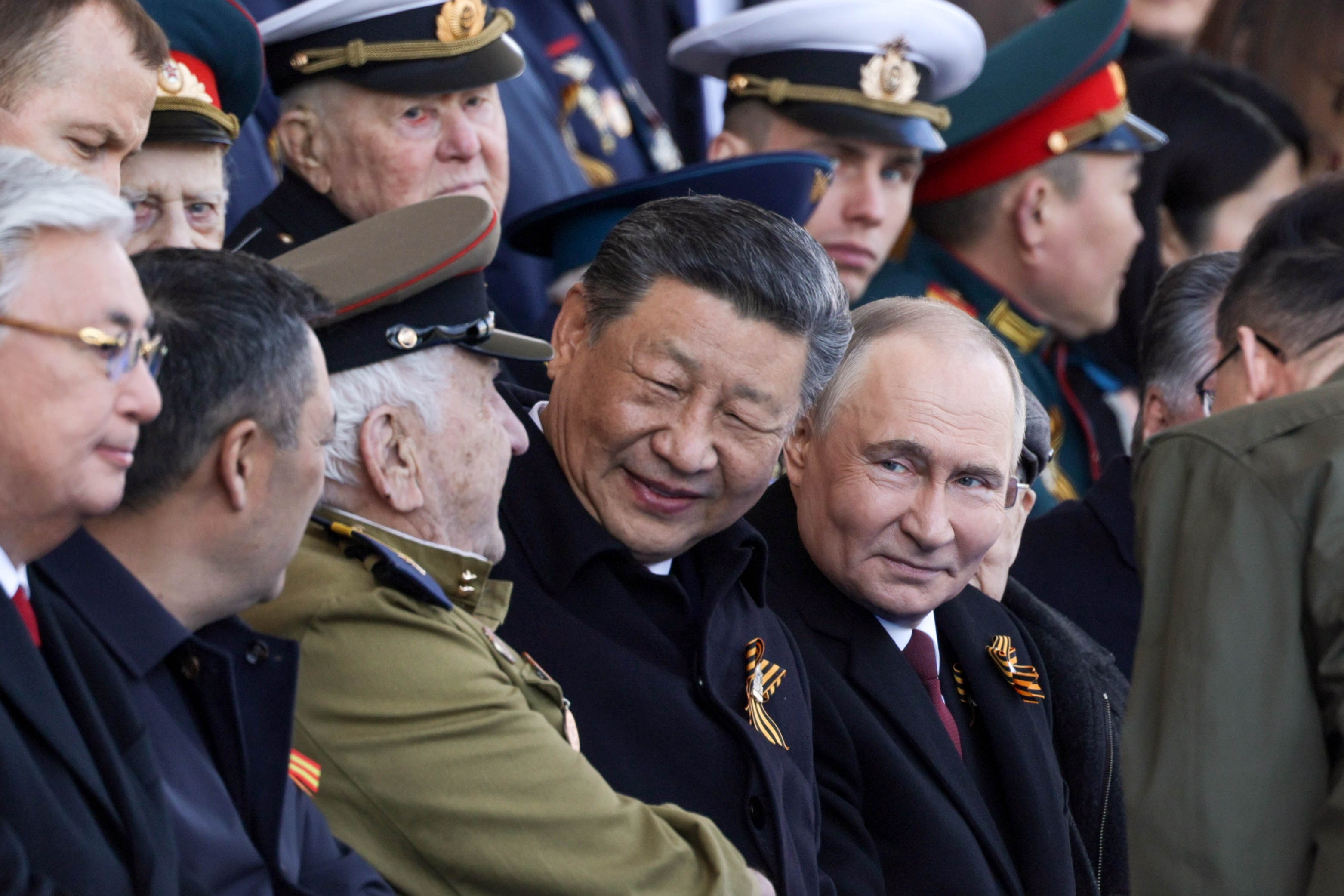
Synchronised Victory Day anniversary events held by China and Russia reflect the leaders’ mutual support for each other’s foreign-policy ambitions. Source: Gavriil Grigorov (ZUMA Press)
REVISIONISM
China’s Victory Day parade, held in Tiananmen Square in September 2025, along with the People’s Liberation Army anniversary events organised in Chinese embassies worldwide that summer, signal Beijing’s intention to promote an image of itself as the victor in the Second World War.
Russia has used narratives from the Second World War as a tool of influence for a quarter of a century; the emphasis on victory discourse is a relatively new trend in China’s foreign policy. This shift is likely linked to the sharp rise in China’s global ambitions ahead of Xi Jinping’s third term.
China views a victor’s image as a way to support its ambition to reshape the existing world order.
China views a victor’s image as a way to support its ambition to reshape the existing world order, believing it grants the country historical legitimacy to do so. To give global significance to its struggle against Japanese occupation, Chinese-language sources have started to reframe the historical narrative. The Second Sino-Japanese War is now described more broadly as a world war against fascism, with China presented as an anti-fascist force.
In constructing this victor’s image, Chinese historians and officials tend to downplay not only the contributions of the Western Allies but also those of the Soviet Union. However, Russia, which considers itself the Soviet Union’s legal successor, does not seem concerned by the portrayal. In fact, the Kremlin plays along with its valued partner. For instance, an entire passage condemning the atomic bombings of Hiroshima and Nagasaki was removed from a Second World War brochure prepared for guests at Russia’s own Victory Day celebrations. One possible reason for this removal – given that Xi Jinping was the guest of honour – may have been the Kremlin’s desire not to undermine China’s narrative of victory by highlighting events that ultimately determined the end of the Sino-Japanese War.
COOPERATION OVERRIDES DISTRUST
Academic institutions close to the Chinese and Russian governments recognise the risk that one side might strike a deal with the United States behind the other’s back. To mitigate this risk, numerous closed-door consultations have been held since early 2025 at China’s initiative to exchange information and coordinate bilateral cooperation. Despite a certain level of mutual distrust, both China and Russia recognise that, for the foreseeable future, they will benefit more from maintaining good relations with one another than from pursuing potential agreements with the US administration.
This does not rule out the possibility that Russia may attempt opportunistic deception manoeuvres towards the United States to enhance its own position. If Russia does pursue such actions, its leadership will likely calibrate them to ensure nothing jeopardises its relationship with China.
It is worth acknowledging that straying from the principles of a values-based foreign policy serves the interests of both China and Russia equally: any concessions made to Russia would, in effect, also fuel China’s global ambitions.