2.1
Russia’s leaking ‘research vessel’ stranded in NATO-dominated waters
A shift in the Kremlin’s perception of threats has led it to devise a new framework for the Baltic Sea region that would allow it to analyse regional challenges and give Moscow fresh opportunities to exert its influence.
In official Kremlin discourse, the Baltic Sea region is now described as the ‘Baltic–Scandinavian macro-region’, a label used to mask efforts to re-establish contacts with researchers and policymakers in the area.
Western scholars who take the bait of Russian ‘scientific cooperation’ may unwittingly serve the Kremlin’s interests.
In our 2025 annual review, we described how Russia employs its academic institutions and research centres as tools of shadow diplomacy in the West. This year, we look at how those structures are being utilised in more tangible ways. Specifically, we will examine how the Kremlin aims to re-establish its influence in the Baltic Sea region, referred to in Moscow as the “Baltic–Scandinavian macro-region”, through academic channels.
The concept of the Baltic–Scandinavian macro-region (BSM), also known as the “Greater Baltic”, gained traction in the Kremlin’s corridors of power after Russia launched its full-scale war against Ukraine. One trigger was a shift in Russia’s perception of threats, particularly following Finland and Sweden’s NATO membership, which significantly altered the security environment in the Baltic Sea. Additionally, Russia’s strategic position in the region has weakened, as the country lost access to key regional cooperation formats, such as the Council of the Baltic Sea States and the Nordic Council of Ministers.
These new circumstances prompted the Kremlin to establish a new framework for the Baltic Sea region. This framework is designed to help assess the challenges in the area and give opportunities for Moscow’s senior leadership to exert influence. The advancement of the BSM concept has been spearheaded by the Presidential Administration’s Directorate for Cross-Border Cooperation, which has planned and coordinated Kremlin policy towards the Baltic states and Belarus since 2021. In 2023, the BSM concept expanded to include Finland, Sweden, Denmark, Norway, Germany and Poland.
NEW CONCEPT, OLD METHODS
In line with Kremlin practices, the Directorate for Cross-Border Cooperation also employs individuals with backgrounds in the intelligence services, enabling intelligence-style methods to pursue its objectives. This includes a broad network of front organisations, some of which appear to be independent Russian academic and research institutions.
In 2022, the Directorate instructed Russian research institutions to create research units focused on the Baltic–Scandinavian macro-region. Their main task is to provide the administration with essential analyses. Additionally, Russian researchers were instructed to leverage their connections with scholars in the Baltic Sea region to reestablish links with regional policymakers.
The influence of the Presidential Administration extends deeply into this network of BSM research units. It not only approves the research topics of BSM laboratories but also determines the roster of researchers involved in these projects. The analyses produced by BSM researchers, along with reports on their contacts with scientific communities in the Baltic Sea states, go primarily to supervisors in the Presidential Administration and to the security services.
This demonstrates that the research conducted under the BSM umbrella, and the surrounding academic engagement, do not represent genuine academic freedom. They are merely a facade behind which the Russian state apparatus pursues its political ambitions.
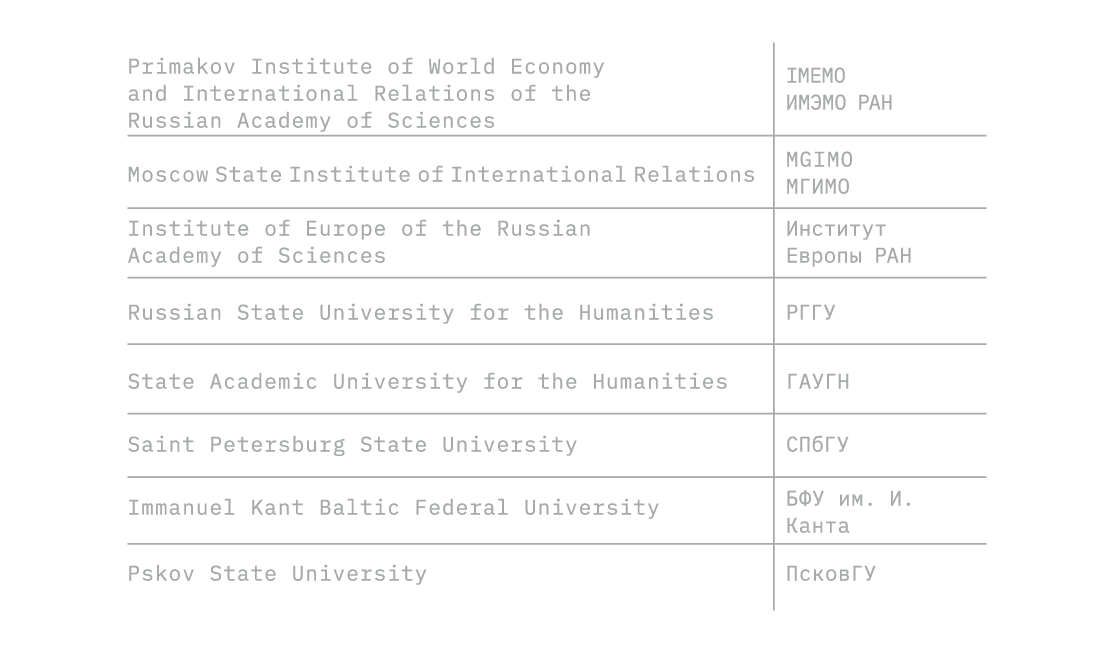
THE BALTIC PLATFORM
One of the products of the BSM concept is the international discussion format known as the Baltic Platform, through which the Kremlin aims to revive connections with scholars, politicians and local authorities in the Baltic states and the Nordic countries, presenting it as an effort in academic cooperation. The initiative follows a particular logic: dialogue begins with non-political topics, such as environmental problems in the Baltic Sea, but gradually shifts to more political matters, including the security architecture of the Baltic Sea and Europe, sanctions policy against Russia, and related issues.
The Kremlin’s efforts with the Baltic Platform, however, have largely failed. After more than two years, it has been unable to foster active exchanges between Russian scholars and their counterparts in the Baltic Sea region. As a result, the Russian researchers on the Baltic Platform – effectively treated as pariahs – primarily cross-pollinate among themselves. To create a facade of international participation, the organisers have included scholars from Belarus – a Russian vassal state – along with “experts” from China, India and other countries. By adding this international dimension to the supposed academic cooperation, Russia seeks to conceal its lack of new experts with in-depth knowledge of the region’s states, languages, societies and cultures.
‘SCIENTIFIC COOPERATION’ AS A TOOL FOR THE RUSSIAN SECURITY SERVICES
It is important to recognise that all of Russia’s international scientific cooperation initiatives are part of the Kremlin’s influence apparatus, which is intertwined with the security services. They bear no resemblance to normal academic research or academic freedom.
Western experts invited to BSM conferences or video meetings should assume that Russian researchers will primarily use any information they obtain for hostile purposes.
The same is true of proposed scientific cooperation initiatives within the Baltic–Scandinavian macro-region: they do not represent a genuine Russian interest in the ecological well-being of the Baltic Sea. Instead, the Kremlin utilises this framework to reassert its political influence in the area. To achieve this, researchers loyal to the Kremlin may deliberately instil fear in the Baltic Sea community by presenting scenarios of environmental disaster. Their goal is to convince the region’s states that, to prevent the worst outcomes, they must inevitably engage and cooperate with Russia.
Western experts invited to BSM conferences or video meetings should assume that Russian researchers will primarily use any information they obtain for hostile purposes, particularly to identify the vulnerabilities of the Baltic Sea states and their allies. As a result, participation in these events, whether intentional or not, may contribute to analyses provided to Kremlin officials, which often include policy recommendations that could harm the interests of the Baltic Sea region, as well as NATO and EU member states along the Baltic coast. For instance, researchers from the BSM network have advised Russia to:
- interfere in the domestic politics of the Baltic and Scandinavian states;
- undermine their foreign, security, economic and energy policies;
- accuse these states of violating the human rights of Russian-speaking and indigenous communities;
- accuse these states of persecuting the Russian Orthodox Church and falsifying history.
The most effective way to counter these influence operations is to avoid all collaboration with universities, research institutions and expert networks from Russia and Belarus altogether. Ironically, Russia has unintentionally created its own antidote to its influence efforts: by waging war against Ukraine, it has isolated itself and lost most of its connections to the West. As a result, the metaphorical “BSM research vessel”, now stranded in the backwater of what has become a NATO-dominated Baltic Sea, is already beginning to rust and take on water.
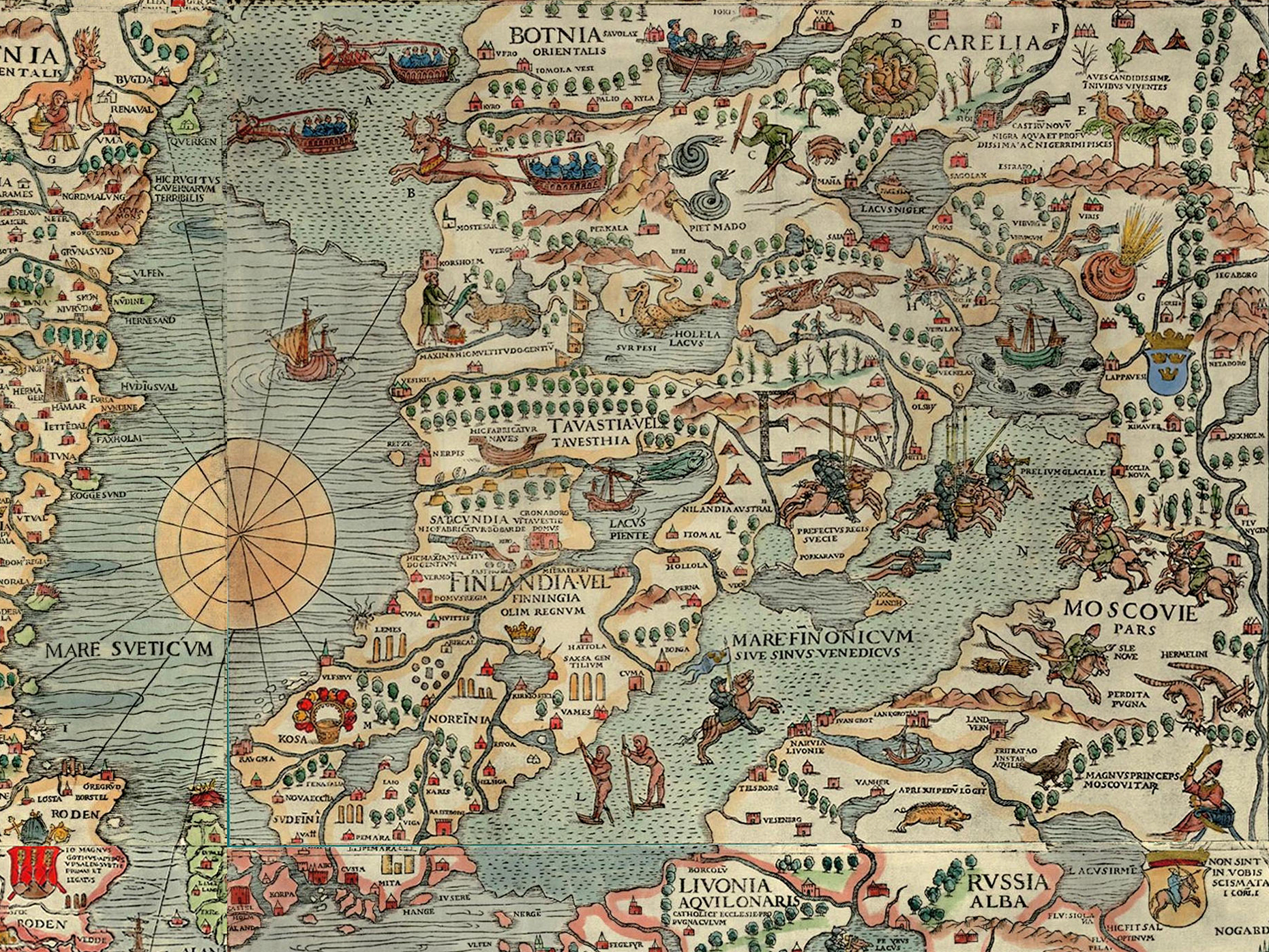
Back to the past? Researchers of the Baltic–Scandinavian macroregion portray one of the world’s most peaceful regions as an arena of escalating confrontation between Russia and the West. Source: Olaus Magnus. Carta marina et descriptio septentrionalium terrarum (1539).